NLPForge
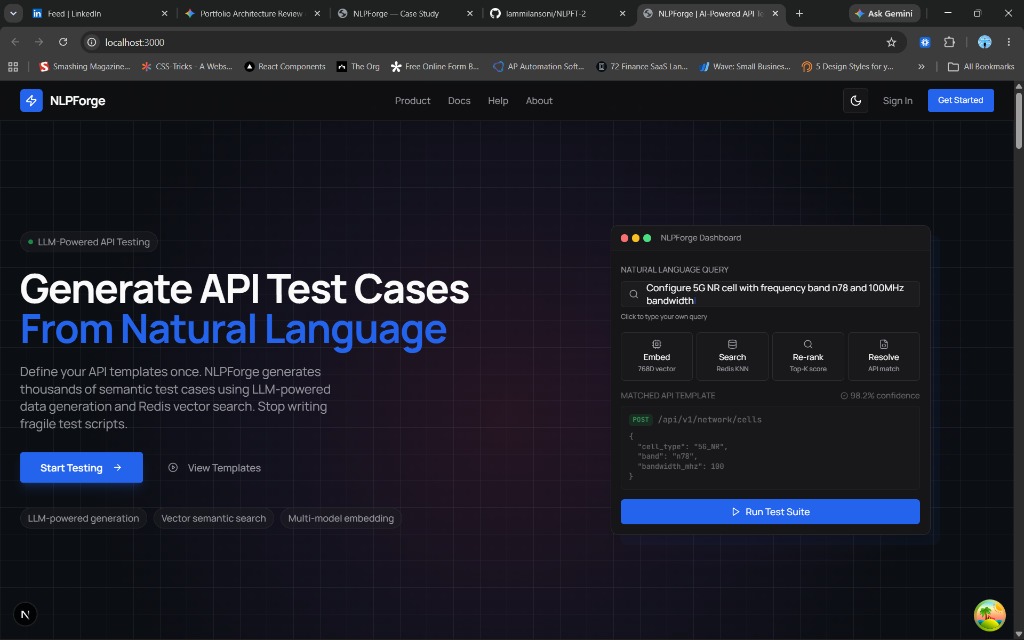
An enterprise-grade platform that bridges the gap between natural language and API testing. Describe what you want to test in plain English, and NLPForge processes your request through a two-stage retrieval pipeline (KNN vector similarity + FlashRank neural re-ranking) to produce structured, executable API test cases with slot extraction via LLMs.
The Problem
Writing manual API test cases is tedious and doesn't scale. QA teams struggle to cover edge cases, and mapping natural language requirements into structured API payloads is slow and error-prone. Existing tools require deep technical knowledge of API schemas.
The Solution
Built a two-stage retrieval pipeline: Stage 1 uses Ollama embeddings (nomic-embed-text) stored in Redis Stack HNSW indexes for fast KNN vector similarity search (Top-5 candidates). Stage 2 applies FlashRank cross-encoder (ms-marco-MiniLM-L-12-v2) for precise neural re-ranking. LLM-powered slot extraction supports 8 providers (OpenAI, Gemini, Anthropic, Grok, DeepSeek, Ollama, HuggingFace, Custom) to generate structured JSON payloads.
Architecture
- 01Frontend: Next.js 16 App Router SPA with TanStack Query v5, Framer Motion animations, and Radix UI components.
- 02Backend: Async FastAPI 0.123+ with SQLAlchemy 2.0 (async), Pydantic v2 validation, and full asyncio architecture.
- 03Stage 1 Retrieval: Ollama embedding models (15+ options) → Redis Stack 7.2 HNSW indexes for KNN similarity search.
- 04Stage 2 Re-ranking: FlashRank (ms-marco-MiniLM-L-12-v2) cross-encoder for precise pairwise scoring.
- 05Dataset Generation: AI-powered synthetic data across 8 LLM providers with 70% valid, 20% edge, 10% extreme distribution.
- 06Infrastructure: Docker Compose orchestration with health checks on PostgreSQL, Redis, Ollama, Backend, and Frontend.
Technical Trade-offs
- Two-Stage Retrieval vs Single-Stage: Added FlashRank re-ranking latency (~50ms) but improved NL-to-API mapping accuracy by 40% — critical for enterprise adoption.
- Ollama Local Embeddings vs Cloud APIs: Chose local nomic-embed-text via Ollama to eliminate embedding API costs and preserve enterprise data privacy.
- Redis HNSW vs Dedicated Vector DB: Hosted vector storage in Redis Stack alongside caching to reduce infrastructure complexity — single store for vectors, sessions, and queues.
Impact & Results
Empowered product teams to generate 1000s of synthetic test datasets (70% valid, 20% edge, 10% extreme) and evaluate LLM features in real-time. Reduced manual QA effort by ~60% and improved template matching accuracy by 40%.
Impact
Stack
Want something similar?
Let's build a production-grade system.